







I’m always surprised to see so few articles on making syrups. It’s an easy, relatively quick and very versatile preparation, which can be so delicious that syrups are also made for the taste pleasures they offer. There are many other recipes available on the web. The aim of this article is to give you the basics to enable you to create your own syrups. For me, this freedom is essential if you want to use the plants in your garden and increase your autonomy.
The benefits of syrup
With so many possibilities, syrup should be a favorite transformation for herbalists and gourmets alike. In this article, I hope to clarify the basic principles to give you the confidence to improvise your own recipes.
The syrup principle
A syrup is a mixture of a concentrated aqueous phase, called a decoction or reduction, to which a preservative, typically sugar, is added. This text also explores possible alternatives to sugar as a preservative.
The choice of preservative and the quantity used influence taste and shelf life.

Rituals to get most of your Herbal Syrup
Keep syrup in the mouth to better mix with saliva before swallowing.
Insalivation often increases the assimilation and speed of uptake of the syrup’s active ingredients, another good reason to make a syrup with a taste you like. Experiment with different syrups and don’t hesitate to send me your comments.
Dilute syrup in a glass of water
Syrups are by nature highly concentrated; as this concentration may make the syrup less appealing to some people, there’s no problem in diluting it in a glass of water or juice. Often, dilution in water makes it easier to discern the rich taste of a preparation.
Syrup production method
- Add pure water at room temperature to a pot over low heat;
- Choose and measure the quantity of plants used for the syrup (generally between 30 and 100 g of dried plant or 500 g of fresh plant per liter of water);
- Add tougher plant parts such as roots, seeds, berries, mushrooms and bark at the start;
- Continue to let the water evaporate to 3/4 of the desired concentration;
- Add tender parts such as leaves and flowers;
- Continue to let the water evaporate until the desired concentration is reached;
- Remove from heat;
- Add aromatic herbs (those with high levels of volatile active ingredients);
- Put the lid on and wait 2 to 3 hours for the mixture to cool;
- Strain the preparation, taking advantage of the cool-down period to squeeze out as many active ingredients as possible;
- Add preservative(s) and mix well;
- Bottle in sanitized bottles and label.
Tips on when to stop reducing
When reducing, it’s difficult to know how much water has evaporated. For your homemade syrup, you can make do with an approximation by eye, but if you want something more precise and repeatable, here are a few tips that may help:
Use a graduated cauldron
With a graduated cauldron, it’s easy to see how much the water quantity has decreased.
Weigh the cauldron and the preparation
Before you start cooking, weigh out your pot with the water and herbs for the syrup.
Based on the chosen reduction, calculate the ml of water to be evaporated. For example, to reduce one liter by half, I want to evaporate 500 ml of water in my syrup. Multiply the volume of water to be evaporated (500 ml) by the density of the water: 1 g/ml: 500 ml X 1 g/ml = 500 g.
Adjust the amount of water evaporated after filtering plants
Once the plants have been removed, you can put the reduction back on a low heat and evaporate a few more ml of water, or add a few more ml of fresh water to the reduction.
Different syrups
When we think of medicinal syrups, we often have 2 or 3 in mind: syrups for coughs, sore throats and cold symptoms. In the words of Cyrano de Bergerac… “ah! non! c’est un peu court, jeune homme! You could say… oh, God! a lot of things, all in all…“.
The beauty of syrup is that it can be used for practically infinite purposes. Here are just a few ideas:
Need inspiration to find plants with the properties you’re looking for? Follow the links!
| Issues | Desired properties |
| Cough, bronchitis, pneumonia | Pectoral, antispasmodic, bechic, expectorant, emollient, immunostimulant, bronchodilator |
| Sore throat | Emollient, antiseptic, immunostimulant, astringent, analgesic |
| Slow digestion | Carminative, digestive, bitter, hepatic |
| Menstrual cramp | Antispasmodic, anti-inflammatory, analgesic |
| Lumbago | Anti-inflammatory, analgesic, antispasmodic, venous tonic, mineralizing |
| Constipation | Laxative, emollient, cholagogue, choleretic, carminative |
| Depurative, spring cleaning | Depurative, diuretic, remineralizing, hepatic |
| Tonic, convalescence | Tonic, remineralizing, adaptogen, regenerator, immunomodulator, nutritive |
| Hangover | Hepatic, choleretic, cholagogue, digestive, anti-emetic or emetic (depending on whether you want to reduce nausea or induce vomiting). |
Preserving agent
Traditionally, sugar (lots of it) is added to syrup to increase its shelf life. We’ll look at alternatives to sugar later in this article.
Sweetening agents
Functions of theese agents
- Improve taste, make medication more appealing (especially if you use very bitter herbs);
- Increase the shelf life of the syrup.
Sweetening agent proportions
If you plan to use the syrup in the next few days and store it in the fridge, the amount of sugar to add is defined by your taste or that of the person for whom it is intended. If you want to use it as a preservative, you’ll need to increase the dose considerably. A low dose of sugar will tend to ferment the syrup rather than preserve it.
For an average shelf-life of 1 to 2 months in the fridge, add the sweetening agent in equal proportions to the aqueous phase (quantity of preservative : quantity of aqueous phase = 1 : 1). This gives 250 g of sugar for 250 g of aqueous phase.
For a long shelf-life, from 6 to 9 months without refrigeration, double the sugar in your preparation. A ratio of between 1.8:1 and 2:1 will considerably increase the syrup’s shelf life. On the other hand, with a ratio of 2:1, syrups tend to crystallize, hence the advantage of using a little less sugar (1.8 instead of 2). Note that crystals are harmless. You’ll need between 450 and 500 g of sugar for 250 g of aqueous phase.
To obtain a preparation with good keeping power, but which is less sweet, it is possible to replace the sugar (in whole or in part) with glycerine or alcohol.
The above proportions are adequate, provided the sweetening agent does not itself contain water. All vegetable syrups (maple syrup, agave syrup or other plant syrups) contain water and are not very good preservatives.
Choice of sweetening agent
White sugar is very economical, but not very nutritious. You can replace it with honey or molasses.
Honey as a preservative
Honey is a good preservative; it replaces white sugar with its nutrients, medicinal properties and texture, which softens and thickens preparations. It is frequently used in syrups and jams. Although honey contains 18% water, its acidity and ability to inhibit bacterial growth compensate for this lower sugar concentration. If you replace sugar with honey as a preservative, you won’t have to adjust recipes.

Honey should not be consumed by children under 1 year of age, as there is a danger of infantile botulism caused by the bacterium Clostridium botulinum. This is a rare but very serious disease. For your baby’s sake, be vigilant!
This box is an extract from the article: Honey, a noble solvent, preservative and superfood.
Molasses
Molasses is derived from the refining of sugar (extracted from sugar beet or sugar cane). It has 25% fewer calories than sugar, is slightly more nutritious (vitamin B, calcium, potassium, iron, copper) and less expensive than honey. Molasses thickens syrups considerably, giving them an even syrupier consistency. Molasses can be substituted for sugar in syrups (1:1 ratio).
Vegetable glycerin
Glycerine can also replace sugar in the same proportions (1:1 ratio). Glycerine and sugar can be mixed.
For example, for a long-lasting syrup (2:1 ratio), 250 g of aqueous phase would normally contain 500 g of sweetening agent. These 500 g can be divided between sugar, molasses, honey or glycerine. For example, you could have 250 g of glycerine and 250 g of honey.
The advantages of using glycerine are:
Find out more about glycerine in the article: Glycerine, an astonishing solvent
Alcohol as a preservative
Alcohol is an excellent preservative. Using alcohol reduces or eliminates the sugar in syrups (when all the sugar is replaced by alcohol, the preparation changes its name to tonic). Since much less alcohol is needed than sugar, doses are smaller and fewer bottles are required. On the other hand, alcohol is incompatible with children.
1 part sugar can be replaced by 0.1 part 40% alcohol to obtain a similar keeping power.
For example, use 25 ml of 40% alcohol for 250 ml of aqueous phase (1:10) for a syrup that will keep for 1 to 2 months in the fridge. If you want a syrup that will keep at room temperature for at least 6 months, double the amount of alcohol: 50 ml of 40% alcohol for 250 ml of aqueous phase (1:5).
It is possible to mix alcohol and sugar… simply by respecting the proportions.
Replace alcohol with alcohol-based liquid concentrates

Alcohol is a complementary solvent to water. So, instead of using ordinary 40% alcohol, it’s a good idea to use an alcohol-based liquid concentrate. You’ll then potentially have access to a greater quantity of a plant’s active ingredients (totum). Unfortunately, making your own liquid concentrates takes a few weeks; if you don’t have any, ask your herbalist.
Vinegar-based liquid concentrates
Herbal vinegars can be added to syrups. Vinegars have a slightly longer shelf-life than syrups, but contain too much water to be considered as preservatives. The addition of vinegar does not affect the quantity of preservative required.

Calculate the quantity of syrup to take
When we take a syrup, we consume a small quantity (a few spoonfuls) compared to a cup of herbal tea, i.e. 4 to 17 times less. That’s why we concentrate the aqueous phase. There are two ways of concentrating our aqueous phase:
Calculating equivalents is especially important with plants that have side effects at high doses. Because of the high concentrations involved, calculating proportions is an approximation, giving a concentration similar to that of herbal tea or decoction.
If your syrup contains several plants, calculate the water/plant proportions individually, then add up the total quantity of water and plants.
Depending on your preferences, I offer 2 methods for calculating your quantities. The table method, which avoids complicated calculations but is more restrictive. And the grand calculation, which lets you vary dose frequency, quantity per dose and preservative proportions as you wish.
Use calculation tables
- Define the plants for your syrup;
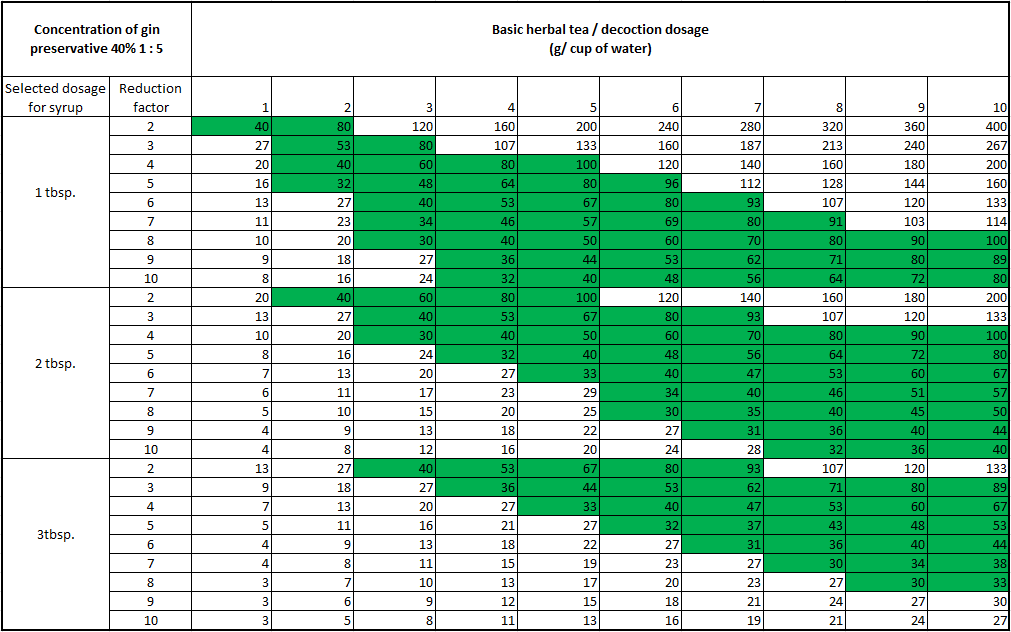
- Find the dosage of the herbal tea / decoction of each plant in terms of g / cup of water;
- Define a syrup dosage (1 to 3 tablespoons) and a reduction factor that works for all the plants chosen (most of the boxes in green or close to it);
- Find the number of grams of each plant and calculate 1 liter of water per plant.

Example
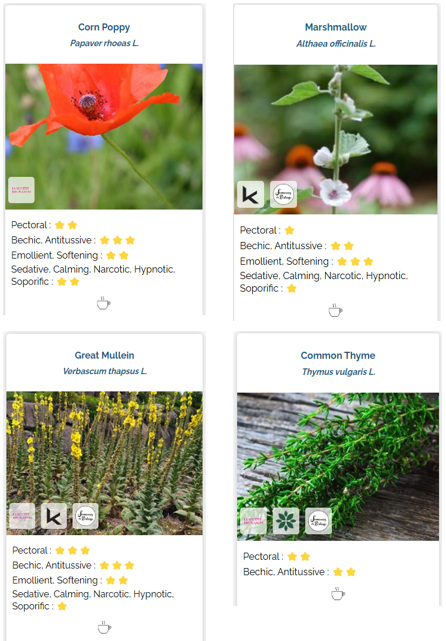
Example: I have a severe cough that prevents me from sleeping. I’m looking for plants in my garden (either in the application or within the plants cards) that have some of these properties: pectoral, bechic (anti-cough), emollient, immunostimulant and sedative. Of course I could also look within the Wiki for the best plants, but I like to start with what I already have.
For my syrup, I choose marshmallow – Althaea officinalis L. (3 g/cup), mullein – Verbascum thapus L. (1 g/cup), thyme – Thymus vulgaris L. (2 g/cup) and poppy – Papaver rhoeas L. (3 g/cup).
I choose a dosage of 1 tablespoon and a reduction factor of 6;
Using honey at a ratio of 1.8:1;
Based on the first table, I’ll use the following quantities to make my syrup (I could obviously make a half recipe):
The marshmallow root is added at the beginning, the mullein is added when the 4 liters have been reduced to 1 liter, and the aromatic thyme and fragile poppy are added off the heat, when 660 ml of water remain for the 4-hour infusion.
Calculate the equivalence between a decoction or infusion and a syrup
Example: I want to calculate the quantity of plant (QP syrup) for a dosage equivalent to the following decoction: 3 g root / 250 ml water.
Where QPdecoction = 3 g; QO decoction = 250 ml
I define the quantity of syrup to take (Qsyrup): 2 tbsp = 30 ml.
I define the reduction of the decoction by 5 (Rd):5 without unit)
I define the ratio (quantity of preservative (Qpreservative) : quantity of aqueous phase (Qaqueous phase) = 1.8 : 1
The factor 4 in the formula is used to convert the 3 g of root per cup into 12 g per liter = 1000 ml/250 ml = 4 (without unit).

Calculate the reduction factor
If, on the other hand, I want to use 50 g(QPsirop) of plant and would like to know the reduction factor of my aqueous phase:

So if we start with 1 l of water, we want to reduce this aqueous phase to around 180 ml. This figure is more an order of magnitude than an exact measurement. Get inspired by these tips to be able to repeat your recipes.
Taking care of yourself
Coughs can sometimes have serious causes (cancer, emphysema) or complications (pneumothorax, syncope, epilepsy, ruptured aneurysm, etc.): don’t hesitate to consult a doctor in the event of a chronic or very severe cough.
Some plants are more sensitive to use than others. For example, if you’re making a nutrient syrup or an adaptogen syrup, the dosage can easily be approximated. But this is not the case for all plants. Be sure to check the plant cards before using them. Some plants have strong side effects when taken in high doses. The calculations above give you some guidelines for converting herbal teas and decoctions into syrups. We’re all different, so a safe method is to start using a new syrup with a reduced dose and gradually increase the dosage. Remember, plants are natural but powerful!
Plant mix and water saturation
The above calculations do not consider water saturation. Even if we start with the purest water possible, when we use water as a solvent, it uses the positive and negative charges of theH2Omolecule to attract the active ingredients to dissolve in the water. In so doing, water becomes saturated and loses its power as a solvent. In a syrup, although the solution is heated for longer, higher concentrations of herbs are used than in herbal teas, so the extraction of active ingredients is inevitably poorer. It is not very effective to use more than 100 g of dried plant per liter of water.
Photo credit
Photo wild thyme: Summi