







Drawing up a vegetable garden plan allows us to reflect on it and adapt it, so that it gives us maximum satisfaction. I don’t believe there’s just one optimized vegetable garden, because we always optimize according to our available resources and our objectives. This article is not an absolute truth, but offers some food for thought; sometimes, one or two small changes can bring a great deal of satisfaction.
Once you’ve decided on the type of vegetable garden you want, the next step is to determine its size.
Vegetable garden plan: ideal and available resources
Time available
Obviously, your choice of crops, the type of vegetable garden, your growing practices and your need for performance will greatly influence the time you spend in the garden. In this article, I offer some tips on how to get the most out of your vegetable garden according to your objectives. Even so, for a 50m2 vegetable garden, you’re looking at an average investment of 1 hour a day.
Take a moment to clarify what motivates you, what you want to experience with your vegetable garden:
- Food self-sufficiency
- Savings on groceries
- Family activity, vegetable gardening with the kids
- Creating beauty and diversity
- Mainly for pleasure, with the added bonus of eating it.
- Get outside and do some exercise (in line with your physical capabilities)
Tisanji offers a garden design and planning application. You’re free to use it. Just click on the blue button to access it.
Space required
For those seeking to achieve food self-sufficiency, we’re usually talking about 50 m2 per person. Obviously, achieving food self-sufficiency is a lifestyle choice, which also requires a good investment of knowledge and time, as well as a substantial plot of land.
At the other end of the spectrum, we find the person who wants to set up their first vegetable garden, the one who has to set everything up (and sometimes buy their first gardening tools). The one who explores different options to find the gardening style and crops that suit her. The one who only has a balcony and is limited to a few pots. Consider the time it takes to get the garden up and running in the spring, and the learning curve for gardening efficiency. If you’re alone in your project and have no experience, I wouldn’t advise you to start with a vegetable garden larger than 20 to 30 m2. If you get the taste for it, you can install occlusion cloths to prepare, for the following year, a larger vegetable garden that will benefit from all the experience of your first year of cultivation.
Available space
Look for ideal locations:
- Flat land
- Good drainage (where water doesn’t stagnate too much)
- Protected from strong winds
Identify and delimit the space according to sunlight zones: full sun, semi-shade and shade. These zones can be identified based on observation, but don’t forget that this summer deciduous trees will produce much more shade than in winter.

Import an aerial photo to define available space
Import an aerial photo (e.g. Google Earth) of your plot into tisanji to quickly define the available space and position trees and buildings that produce shade on your plot.
As an alternative to Google Earth, in France, there’s an excellent site for extracting your aerial view as well as several filters useful for agricultural activities: géoportail. It’s very well done.
What if the ideal spot doesn’t exist on your plot?
Don’t let the constraints discourage you. Quite often, they are the inspiration to create your own unique vegetable garden. Here are a few suggestions for playing with constraints.
Vegetable garden plan: adapting crop choices
Sometimes, constraints stimulate discoveries. Looking for species that are adapted to your conditions can lead to great finds.
Here are a few shade-tolerant crops (with a minimum of 2 hours of sun a day): lettuce, radish, sorrel, rhubarb. Also, did you know that the popular hosta is edible (and even interesting, with its taste reminiscent of cabbage before flowering)?
If your land is on a slope, you can use the top of the slope for plants that require little water(rosemary, lavender, thyme, garlic, carrots, onions, etc.) and, on the contrary, install thirsty plants at the bottom of the slope: solanaceous plants(tomatoes , eggplants), blackcurrants, broccoli, cabbage, Swiss chard, etc.
Adapting your land to your crops
There are plenty of ways to modify the growing conditions on your land.
- Adding hedges reduces wind
- Raising the beds improves drainage
- Amending soil improves drainage or water retention
- Installing large, fast-growing plants can increase shading
- Planting plants reduces soil erosion (both wind and water)
- Use gradients to redirect surplus water
- Create several small terraces to maximize the use of water by circulating it from top to bottom.
Vegetable garden plan: strategies for increasing harvests despite limited space
Choosing high-yielding plants:
Some crops produce more mass than others…
Some examples of high-yield crops grown as tightly as possible: tomato (5 to 13 kg /m2), carrot (5 to 7 kg /m2), bean, cucumber and turnip (4 to 7 kg /m2).
Compared with less productive crops: strawberries (1.5 kg /m2), garlic and cauliflower (1.5 to 2.5 kg /m2) , zucchinis and peppers (2 to 4 kg /m2).
Staggered planting
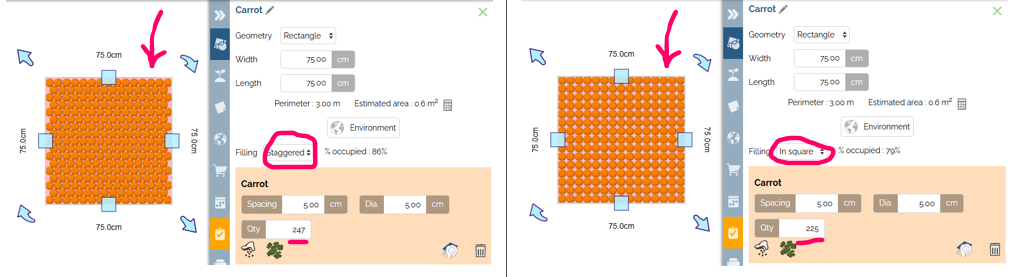
When plants are placed in staggered rows, you gain around 10% on larger surfaces.
Increase crop density
We can generally increase yields by increasing crop density. Of course, this comes at a cost. Generally speaking, the fruits and vegetables produced are more numerous (increased total mass), but individually smaller. Also, harvesting these often intertwined plants will be much more difficult. Finally, too high a density is conducive to the development of fungal diseases, which appreciate the lack of aeration. Finally, high crop density increases stress on soil nutrients: don’t forget to amend your soil accordingly, and practice crop rotation.
Choose fast-growing plants and grow several crops a year.
Here, the idea is to use the same space to produce 2, 3, 4 or even 5 successive crops in a single year. The champions of this technique were Parisian market gardeners, who at the beginning of the last century were already able to harvest up to 8 crops per plot without chemicals or mechanization. To maximize successive harvests, you need to take advantage of the plants’ ability to tolerate a light frost (spinach, radish, lettuce, lamb’s lettuce) or, on the contrary, the heat of a heatwave (arugula, bok choy, beans, peas).
Stretching out the seasons
Plenty of solutions exist for gardeners who want to stretch their season.
Greenhouses and indoor seedlings are classic options, but floating covers, tunnels, cold frames and cloches also act as thermal barriers that extend the growing period.
A growing number of books on winter farming now offer even more inspiration.
Standardized beds make it easy to reuse floating covers and tunnels
If you’re planning to use floating covers and tunnels, it’s a good idea to have standard size of rectangular garden beds to enable better reuse.
Transforming decorative flowerbeds into gourmet flowerbeds
There are many edible plants that are also aesthetically pleasing. Combining the useful with the aesthetic, these dual-purpose beds could be just the argument you need to convince your partner to expand the vegetable garden on the plot. If you opt for this solution, remember to group annuals and perennials together, to limit disturbance to perennial roots when planting annuals.
If your decorative beds already have perennials, then this is often the ideal place to add perennial edibles that will yield harvests year after year with little effort.
Until a few years ago, front-yard vegetable gardens were frowned upon. Many municipalities still have bylaws restricting their creation. But these bylaws are no longer in vogue, and since the Quebec government put “its vegetable garden” before parliament, municipal laws are slowly following suit. Perhaps a little too slowly; if you’re the first in your neighbourhood, it’s a good idea to get informed before planting. The aesthetics of a greedy flowerbed will certainly be more readily accepted by your conservative neighbors… After all, gardening is an active way of helping to change attitudes.


Vegetable garden plan: choosing a location for edible plants
This step can be very quick for monoculture enthusiasts. You put one plant per bed, so all you have to worry about is crop rotation, sunlight and irrigation requirements.
Knowing how many plants fit into a surface
Manual method for square surfaces
To do this step manually (for those who prefer to use paper and pencil), simply divide the area of the surface to be occupied by the spacing of the plant in the square. This gives you the number of plants that fit into a square layout. If you intend to plant in staggered rows over a relatively large area, you can add 10% to the number of plants that fit into the surface.
Use tisanji for more complex situations
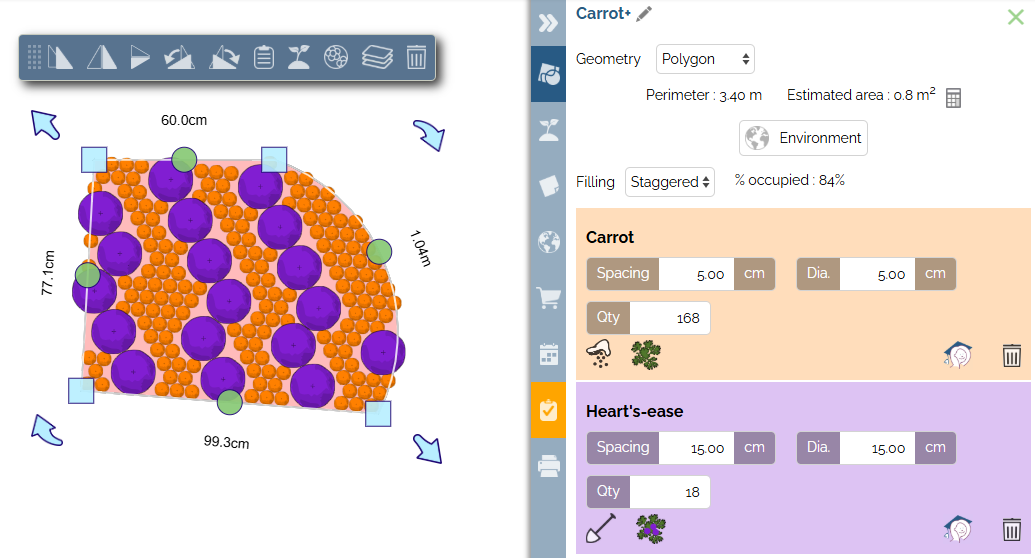
Things get complicated when you want to mix several species on a complex surface. In this case, the easiest thing to do is to draw the plants one by one, or better still, use tisanji to place them for you. 😏
Reasons for mixing cultures
If you want to make efficient use of an area for several intermingled species, the most efficient (read: least effort) solution is to direct seed with a mixture of selected seeds. If you want to create a mixed bed in a more controlled way, this solution generally requires a greater investment of time than monoculture. Even so, it’s a common practice. Here are just a few of the reasons why gardeners opt for these mixes:
- The ornamental aspect, the beauty that emerges from a well-matched mix
- Have more varieties and smaller quantities of each variety
- Reduce pest damage: when dispersed, plants are harder for pests to find, and if damage does occur, hopefully only a few plants will be affected.
- Improve fertilization (mixing melliferous flowers with crops attracts bees and other pollinators close to your edible plants, helping to improve fruiting).
- Taking advantage of the services that companion plants can provide
- Avoid managing crop rotation… If the bed does not contain a high concentration of one type of plant, the soil will be much less depleted, and although it is not advisable to replant the same plants in the same place over and over again, rotation can be much freer if there is no concentration of plants.
Group plants with similar needs (compost and watering).
This should go without saying: we’re going to put together plants that have similar needs in terms of fertilization (compost or fertilizer), water requirements, soil type, and possibly pH.
In practice, managing 4 criteria on a large number of plants can be a little complex.
Here’s a list of plants based solely on water and compost requirements. And we’ve already got 9 categories.
Use multiple filters to find plants with compatible needs
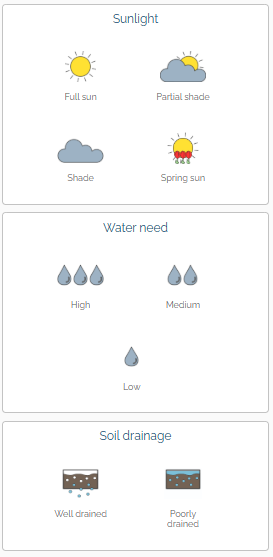
Use the tisanji filters to indicate compost, water, pH and soil requirements. tisanji will provide all the plants, prioritizing those for which the condition is ideal and then those that tolerate those conditions. tisanji also provides information on companion and enemy plants to inspire you.
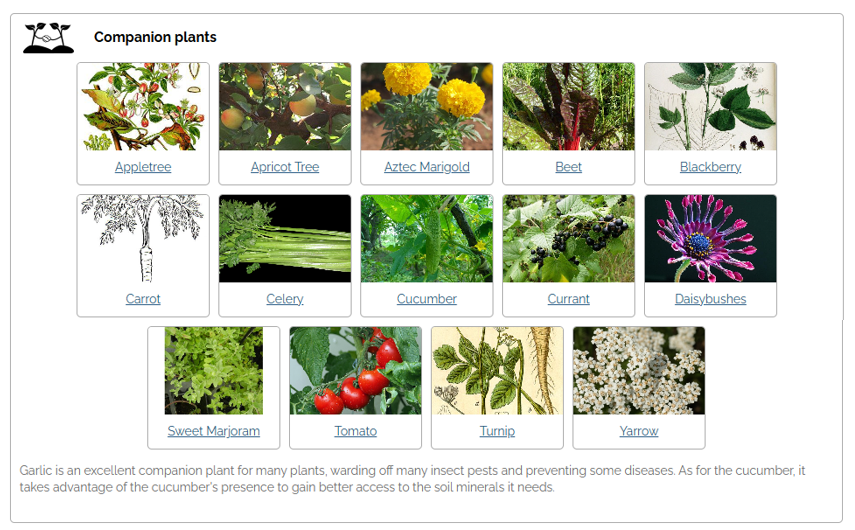
Here are some vegetable crops classified according to their needs:
(Note: most of them will tolerate having a little more or a little less than their ideal needs, but this may influence the taste or yield of the crops).
Plants with low water and compost requirements
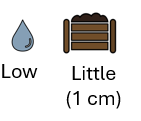


Click on the image to access the full plant data sheet
Plants with medium water requirements and low compost needs
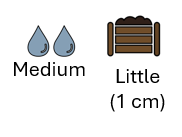


Click on the image to access the full plant data sheet
Plants with low water and medium compost requirements
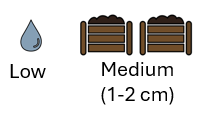


Click on the image to access the full plant data sheet
Plants with medium water and compost requirements
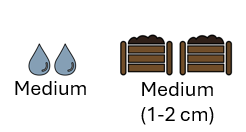


Click on the image to access the full plant data sheet
Plants with medium water requirements and high compost needs
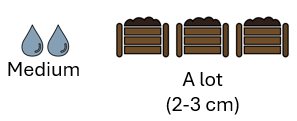


Click on the image to access the full plant data sheet
Companionship principle
There’s a lot in the literature and on the web about companionship. The famous laidback gardener (Larry Hodgson) reports that there are many myths behind the concept. However, more and more authors are deconstructing companionship, explaining why these plants make good companions. These analyses bring rationality to the concept, but they are not absolute. Depending on climate and situation, the interaction between micro-organisms, pests and different species can vary. These are not absolute truths, but they are certainly interesting avenues of exploration.
List of arguments in support of certain companionships:

- The plants have similar growing conditions (see above).
- Plants have cultivation times that allow them to maximize their surface area. For example, the artichoke is a plant that takes time to develop into the large plant it will be at the end of the summer… in spring, we therefore have time to start many intercrops that will occupy the space instead of weeds.
- Plants provide each other with services, such as promoting fertilization, warding off insect pests, reducing the occurrence of disease and so on.
- On the other hand, some plants harm each other by inhibiting growth, attracting pests, or acting as disease vectors.
- Finally, for ornamental plants, we combine plants that have compatible conditions and offer harmonious visual contrasts.
For those who want to delve deeper into this field, I recommend Bertrand Dumont’s book (in French only) which, in my opinion, is the clearest on the subject of companionship and, above all, on the reasons behind these suggestions.
Avoid grouping vegetables from the same plant family together.
This logic is more nuanced than the last two. On the one hand, plants from the same family often have similar crop requirements. In fact, they are so similar that, in terms of soil depletion, mixing species from the same family is almost as costly as growing a monoculture.
Secondly, plants in the same family often attract the same pests. So, by grouping them together, they become more visible, and if by misfortune their flowering and fruiting periods are staggered, we offer pests ideal conditions to reproduce all season long.
That said, this is not an absolute rule. For example, companionship between alliums is generally avoided, but garlic and onions cohabit just fine! And finally, by mixing plants from the same family, we end up in much the same situation as with standard monoculture beds, a model adopted by market gardeners… If it’s good for professionals who earn a living, then it’s a viable solution for most of us!
Creeping and climbing crops
These crops need support to thrive without taking up too much land space. Depending on the nature of the supports, they have a more or less permanent location, which must be taken into account.
Sometimes, one plant can be used to support the growth of another. Take, for example, the famous “companionship” of indigenous peoples: corn, squash and beans. In this partnership, the corn supports the bean, which in turn enriches the soil with nitrogen to feed the squash and corn. As for the squash, it covers the soil and prevents weeds from using local resources. It’s a rational partnership that has proved its worth.
Need protective covers against pests or frost
Are you planning to use floating covers, tunnels or nets to protect your crops?
Think about grouping the plants that will benefit from them… Firstly, grouping them will enable you to use fewer of them. Secondly, although these tools are useful, they’re not the most aesthetically pleasing. Ideally, you should hide them on the edge of your plot, where they’ll be as unobtrusive as possible, if aesthetics are important to you. If, on the other hand, you’re looking for efficiency, perhaps it’s best to place them close to your base, to reduce the need to travel.
Use the tisanji volume and area calculator to help you estimate your needs.
Vegetable garden plan: crop rotations – are they important?
Crop rotations have now become part of the best practices of market gardeners looking for production without exhausting the soil and maximizing the use of soil improvers. The more intensive your crop, the more your model approaches monoculture, and the more crop rotation will be necessary.
If you’re a performance permaculturist who uses standard beds for each of your crops, then yes, definitely! The great advantage of standard beds is that it’s very easy to just move the beds according to the rotation cycle you’ve determined.
If your flowerbeds are well diversified, planning the rotation is more complex and less necessary. In many cases, you can be satisfied with not systematically putting your annuals back in the same places year after year.
Vegetable garden plan: choosing plants for your vegetable garden
Vegetable plants are good; this section aims to keep in mind some alternatives that can be very interesting in your vegetable garden.
Think herbs
Herbs are, for the most part, easy-growing, generally more tolerant plants: if they don’t receive their ideal conditions, they’ll produce anyway. Many of them, with their strong odor, also help protect their neighbors from unwanted visitors. Generally small in size, they are perfect for fitting into holes in the vegetable garden.
Personally, I make great use of fresh herbs in my salads. Their leaves are packed with flavour and nutrients. Also, because we use them in small quantities, it’s much more practical to grow and harvest them as we need them, rather than buying large quantities at high prices that we end up throwing away.
But beware: some herbs are so easy to grow that they can become invasive: I’m thinking of mint, thyme and sometimes lemon balm. I’m not saying don’t grow them, but remember to limit their spread to reserved areas.
For my favorites, I refer you to the following article: Herbs that make salads taste ten times better!
Edible flowers
They’re pretty, they attract bees and other pollinating insects… and they’re edible… Decidedly, it would be wrong to do without them. For your growing beds, favor annual flowers, but you can use perennials in your flowerbeds; they’ll be big “pluses” for aesthetics and neighbors’ acceptance 😊 .
For my favorites, I refer you to the following article: Edible flowers from the garden bloom my salads!
Edible perennials
There are a number of perennials that will enable you to harvest quickly and for several years, without having to buy back… There are great classics like Jerusalem artichoke, wild arugula, rhubarb, sorrel and lovage.
Note that Jerusalem artichokes and lovage can become invasive. Be aware that you are embarking on an abundance that may exceed your expectations.
If you are interested in edible perennials, please use the filters in the plant files. tisanji offers 83 edible perennials, excluding shrubs and fruit trees.
Long-term thinking
Abundance has to be planned. A few years ago, I met a permaculturist who had achieved food independence. When I asked him what he would do differently if he started his project from scratch, he replied without hesitation: I would begin by planting fruit trees and shrubs. It’s true that these plantations take varying amounts of time to produce, but if you’re planning to stay in one place for several years, these large plants are champions of abundance.
Here is a short list of fruit tree suggestions (suggested by A. Mondor)
For those looking for originality
Hardy kiwi

Yes, yes, kiwi in Quebec. There are miniature varieties that are hardy here. They’re said to be small but excellent, and there’s no need to remove the skin. A few constraints: you need at least one male plant for the female plants to produce fruit, and the plants take 3 to 7 years to produce.
My original favorites from the previous year:

Malabar spinach
A climbing plant with a taste vaguely resembling spinach, but much more mucilaginous… It’s a beautiful ornamental vine that adds volume to salads.

Pineapple sage
I swear the leaves and especially the flowers smell and taste like pineapple… not just a vague resemblance, but a really pronounced “head taste”. This plant makes excellent herbal tea, and its late bloom has attracted several hummingbirds to our garden.

‘Bull’s Eye’ cress
Considered a food plant in South America, Southeast Asia and a few island countries, it’s really more of a curiosity (some bartenders use it in cocktails) than a plant you’ll enjoy using on your plates. Indeed, the plant gives a feeling of anaesthesia (a bit like at the dentist’s), but only for a few minutes. It has also been used traditionally to treat toothache.

‘Peter’ Cayenne pepper
This is a very good variety of Cayenne pepper, strong enough for therapeutic purposes, but also suitable for food use. What’s special about this pepper? Its shape. Have a look at the plant sheet to understand what I’m referring to… Guaranteed giggles during the visit to the garden, proving that our inner child still lives within us.
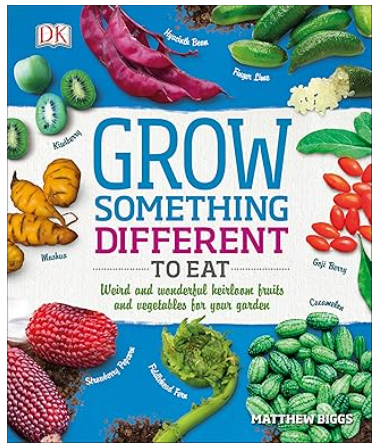
If you want more original ideas for your vegetable garden, I highly recommend the book: Grow something different to eat by Matthew Biggs, which features fifty plants, many of them truly original.
Vegetable garden plan: the tisanji application is the ideal tool for drawing up your vegetable garden and garden plan.
After 6 years of work, and over 2 500 plant sheets, I’m obviously not impartial here. Nevertheless, I believe that with its numerous and very complete plant sheets, and with an interface optimized for intuitive and flexible use, it is ideal for drawing your vegetable garden, modifying it and keeping track of the various tasks in the garden.
Affiliation
Some herbal books are not easy to find in bookshops. For a long time, I went through Amazon but for ethical reasons, I looked for alternatives. In Quebec, I’m affiliated with my excellent local bookseller La librairie Monet. Unfortunately, this is not available in France.
When you use these links to buy your books, you’re supporting an independent bookseller and allowing me to earn a commission (3%), without of course increasing the final price you’ll pay 😉. These commissions enable me to pay part of the costs related to this blog (domain name, blog hosting, etc.) so that I can continue to offer you free content, so thank you if you go through these links to buy these products! And rest assured that I’ll never recommend a product that I don’t sincerely believe to be a quality product: I’m all about bringing you maximum value!

Photo credit:
- Borage: Plenuska
- Capucine: Mary Hutchison
- Shallot: Victor M. Vicente Selvas
- Parsnips: René Hourdry
- Rosemary: Hans
- Turnip: thebittenword_com
- Garlic: Summer Garden
- Chrysanthemum: Rameshng
- Asparagus: Pezibear
- Gombo: Prathyush Thomas
- Lettuce: Rasbak
- Leek: pamsai
- Concern: Yewchan
- Agastache: R. A. Nonenmacher
- Artichoke: C T Johansson
- German chamomile: Mauricio Mercadante
- Celery: Buntysmum
- Kiwi: Linsouciant
- Malabar spinach: Line Guénard
- Pineapple sage: Gabriele Kothe-Heinrich
- Brede mafade: Phyzome
- Capsicum annum ‘Peter’: Brocken Inaglory
Photo credit: jf-gabnor