

It’s never too early to start designing your vegetable garden. It may seem a little extreme to talk about vegetable gardening when there’s still 3 feet of snow in your yard, but you’ll discover in this article why now is the perfect time. You’ll also find the information you need to determine which type of vegetable garden is right for you.
Today, the 75 cm growing bed (proposed by Jean-Martin Fortier #ref:99#, among others) is the most popular choice among organic market gardeners. It’s a model optimized for productivity and profitability, and has proven its worth. But not everyone who gardens has profitability as their primary objective. This article explains the different options with their advantages and disadvantages, so that you can optimize your vegetable garden according to what you want to live.
Choosing the right type of vegetable garden for your resources and needs is important to making your summer experience fully satisfying.
Why design your garden now?
Tisane et Jardin offers a garden design and planning application. You’re free to use it. Just click on the blue button to access it.
The different types of vegetable gardens explored in this article


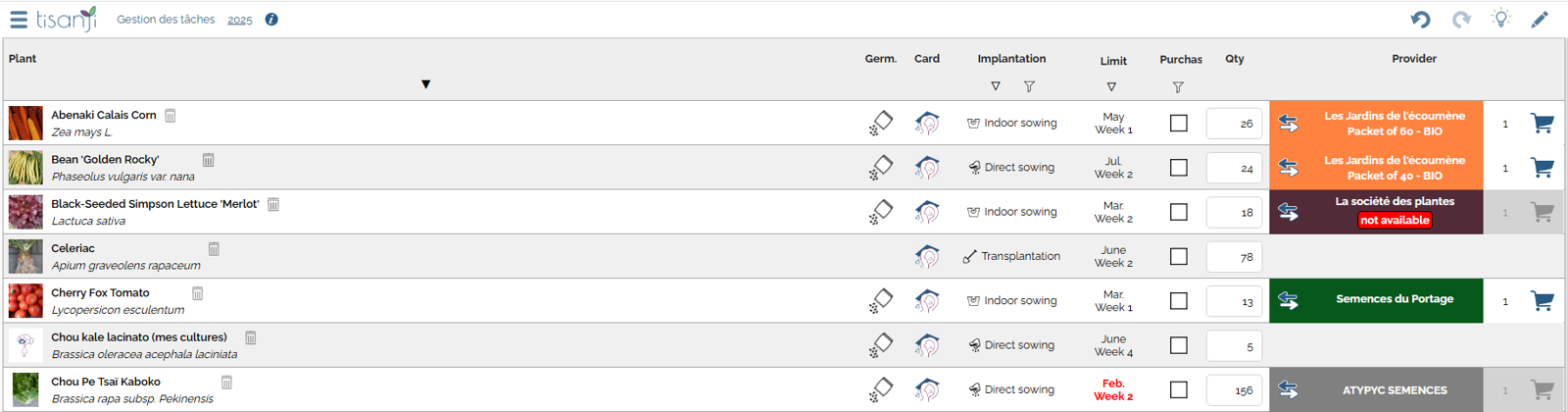
tisanji creates a list of seeds and plants to be procured according to your garden plan, and tells you when it’s time to start the activities.
Once you’ve designed your vegetable garden, you’ll find an inventory (quantity, species) of the seeds and plants you’ll need to create your garden plans. A simple “checklist” adapted to mobile devices, so you can take it to the garden center or track the progress of your purchases on the Internet.
Types of vegetable garden
This article details four types of vegetable gardens and 3 sub-types for the popular permanent bed vegetable garden:
- Individual rank
- Planche permanentePolylang
placeholder do not modify
- Raised vegetable garden
- Nurturing forest
These types are archetypes. Of course, you can have fun playing with their characteristics to make hybrid types. Get inspired without limiting yourself to the model.
1 – Vegetable garden in individual rows separated by a pathway
A vegetable garden inspired by motorized practices, this type of garden is optimized above all for industrial and motorized cultivation. For a manual vegetable garden, the advantages are limited to the speed of initial set-up. This advantage is counterbalanced by an increased need for tilling. In short, in my opinion, it’s the least efficient of the vegetable gardens presented in this article.
Inspiration
Even today, we still see a lot of these vegetable gardens where each row is separated by a mini path… I don’t know why we associate this type of garden with the vegetable gardens of yesteryear. But it’s more like the model used by big-box agriculture, grown with motorized vehicles. If you’re planning to grow your own vegetables “by the armful”, this is not an optimized model. Far too much space is wasted on paths, forcing us to make them so narrow that ergonomics and therefore efficiency in the garden are also affected.
If your soil is light and well-drained (sandy type), with this type of narrow-row garden, it will be difficult and contraindicated to make raised rows. If your soil is heavy and compact (loamy type), these will probably be necessary to improve drainage, but they will cost you more space and every slope between the cultivation row and the path will be a breeding ground for weeds.
In this type of vegetable garden, where the width of the row is determined by the species grown, the soil usually has to be worked every year to decompress it where there used to be a pathway. This type of garden therefore requires recurrent tilling, which is not optimal for the micro-organisms that work in it (generally in a way that is beneficial to the garden’s fertility).

Use pre-punched geotextile fabric to grow crops without weeds.
Using geotextile-type cloths with predefined holes according to the crop very useful. In addition to reducing weeding time, this technique helps to create straight rows with equal spacing. Finally, for crop rotation, simply move the cloths.
This technique works well in vegetable gardens with a flat ground surface. It is also frequently used for raised beds of standardized size.


2 – Type of raised bed vegetable garden
The standard 75 cm bed, the 1.20 m square garden and the free-form gourmet bed have a lot in common. They are 3 variants of the permanent, raised bed. These permanent beds require a greater initial investment to set up than the row vegetable garden. There are a number of more or less time-consuming techniques, such as lasagna layers or simply a good double digging with plenty of potting soil and compost.
The advantage of permanent beds is that they reduce tillage and soil compaction (because you never walk on a bed), which encourages beneficial micro-organisms; so it’s an investment with medium- and long-term benefits for the gardener. As most vegetable plants like well-drained soil, having a raised bed provides better drainage, but if the soil is rather sandy, and if you’re in regions where water is scarce, we sometimes make beds below the paths to help concentrate rainwater in the beds.
The height of the planks depends very much on your soil type: the lighter and more drained the soil, the more difficult and counter-productive it will be to raise the planks (they will then have an elevation of perhaps 10 cm). On the other hand, the heavier and more waterlogged your soil, the more height you can give it (30 cm, sometimes more).
With or without low walls
Many market gardeners live well with these small slopes, with no low walls to hold back the soil… This solution is economical, but sometimes the soil that has fallen into the paths has to be replaced. For urban vegetable gardens, we more often see boards placed across the width to retain the raised soil. There are many alternatives to the plank, such as bricks, rocks and sometimes even tires… The idea is to provide a support that delimits and holds the soil. Obviously, building these little walls is much easier with rectangular planks than with decorative flowerbeds of various shapes.
Market gardeners who want maximum yield per hour will often cultivate beds in monoculture, but more and more gardeners are adopting a companion plant model for the various services plants can render each other.
2a – The standard board (usually 75 cm wide)
The standard 75 cm bed is the ideal type of vegetable garden if you want to optimize the yield/time ratio.
This type of kitchen garden is probably the most widely used by professional market gardeners. The archetype of this model is the ergonomically optimized format proposed by Jean-Martin Fortier #ref:99# with 75 cm wide cultivation beds and 45 cm wide paths. It’s an excellent compromise between efficient use of cultivation space and good ergonomics, enabling optimum efficiency during the various treatments.
Having pre-determined board dimensions increases the reusability of equipment such as tunnels, blankets, tarpaulins, etc., and also allows you to purchase tools ideally sized for your boards. With the success of Jean-Martin Fortier’s book, this 75 cm board model seems to be becoming the standard among market gardeners.
Having boards all close together and identical to each other looks very neat, but personally I find it a little too rectangular. It looks more efficient than natural.


2b – In squares or on boards widened to 1.20 m
The square vegetable garden or the 1.20 m wide bed is the vegetable garden optimized for space. It’s the ideal vegetable garden for those who want to be self-sufficient in food, but on a small scale.
Essentially, the square garden is a defined bed garden, with dimensions of 1.20 m by 1.20 m (or 4 ft by 4 ft).
Ergonomics
These are the dimensions that optimize the yield of the surface. Of course, you’ll find it a little harder to care for plants in the middle (which will be almost twice as far away as plants on a 75 cm surface), especially if you’re not very tall, but you minimize the space lost to pathways. Of course, you save even more pathway space if you lengthen your boards by 1.20 m to make a long row rather than a square.
Crop density
As the principle of the square vegetable garden is to have the most crops per square metre, these crops will normally use a higher planting density (on average, 20 to 40% higher). Planting close together reduces the space available for weeds and generally produces greater volume. Your crowded plants will also be more resistant to wind gusts. On the other hand, the fruit and vegetables produced are generally smaller, and you increase the chances of your plants falling victim to fungal diseases, due to a lack of good aeration. Last but not least, picking will cost you a lot more time, as the plants are further apart and more tangled together.
You’ll understand that it’s very easy to adopt any intermediate width between the 75 cm board and the 1.20 m board, which could represent your ideal compromise.


2c – The gourmet flowerbed
it is the aesthetic choice for amateur gardeners who want to integrate their vegetable garden into their landscaping.
This variant is probably best suited to the home gardener. It is the free-form raised bed. This is a lesser-known model, described in detail by Albert Mondor in his book Plates-bandes gourmandes #ref:158# ). Here, a clear compromise is made between efficiency and aesthetics. The principle of the permanent board can be used for landscaping gardens as well as for mandala gardens, or even for more formal gardens known as “à la française”. Of course, incorporating curves into our planks presents additional challenges:

- You need to work out your layout carefully if you want to maintain good ergonomics. Avoid areas wider than 1.20 m in the square vegetable garden. Having used this model in my own home, I recommend the 45 cm path only where the curves are not too pronounced. Otherwise, you’ll need to widen the path to accommodate a wheelbarrow;
- Low walls are also more difficult to build. I made mine using hemlock planks planted vertically in the ground.
- Here, it’s difficult to install tunnels, and the covers are not interchangeable from one bed to the next.
Before the arrival of the tisane et jardin application, we were limited to rectangular shapes in Excel files or on graph paper and other garden applications. With tisane et jardin, you have total freedom to draw rectangular shapes, ellipses and lines, as well as all kinds of polygons, circular arcs and Bézier curves.
Mixed flowerbeds are also child’s play
Herbal tea and garden algorithms allow you to combine several species in the same area and decide whether you want to place them in a square or staggered arrangement to calculate the number of plants that fit into the area. It’s easy, fast and very practical.
Type of crop
Because efficiency comes2nd, the gourmet flowerbed allows you to mix perennials and annuals. Once installed, edible perennials require less care than annuals, but their permanent position will hinder operations such as soil aeration, which is so beneficial to certain crops (notably root vegetables).
In this model, variety and companionship are maximized to create beneficial and visually appealing synergies. On the other hand, practicing crop rotation becomes both much more difficult and less relevant. We are generally content to move our annuals from one year to the next and prevent the concentration of plants of the same species in a given area.
Another advantage of scattered species and irregular paths is that you’re much less susceptible to pests. In my opinion, gourmet flowerbeds are an alternative that is still too little known. If you’re interested in this type of garden, I recommend the excellent book by Albert Mondor, for which I’ve written a book review.


3 – Type of raised bed vegetable garden
It’s the vegetable garden for people who want good results quickly without fear of hurting their backs.
These vegetable gardens are becoming increasingly popular with urban gardeners. It’s the luxury version of gardening! Ideal for people with back problems or who find it difficult to bend over to work the soil, it’s also the method that requires the greatest investment to set up. Building or buying your own containers and the soil to fill them is therefore more expensive, but this type of cultivation offers ideal ergonomics.
Reduced access for pests, but also for some beneficials
They also provide protection from animals such as groundhogs, which can’t climb into them. Unfortunately, they are also generally unwelcoming environments for precious earthworms. You’ll notice that even if you manually add earthworms to your garden tubs, they don’t live long in the tubs. This is partly because the climate there is less temperate, both in terms of temperature and hydrometry. Raised containers are closed environments that are less resilient than open-ground cultivation, and require more compost or fertilizer additions and frequent watering.
Growing density and planter size
Growing space in raised beds is usually expensive and limited. It is therefore generally maximized by dense planting, as in square gardens. Normally, the larger the planter, the more temperate it will be, and therefore easier to grow. Very small containers (e.g. window boxes) don’t lend themselves to many crops, but most of the models I see are large-format containers (at least 40 cm deep) in which you can grow almost any vegetable.
Growing in outdoor tubs is not optimal for perennials (in northern climates). These plants, which are hardy when planted in the ground, are not adapted to the much colder temperatures that prevail in tubs in winter. Ironically, it’s actually a good idea to plant less hardy perennials in tubs, if you have the space to bring them in (provided they’re movable) during the cold season.
Bottomless bin
Finally, an intermediate solution is the bottomless raised planter (in contact with the soil), to allow the exchange of water and micro-organisms. For water, this is certainly a good idea. For micro-organisms, you need to understand that each type lives in a well-defined stratum of the soil. I don’t think that those living on the surface of your garden will be able to climb up the metre of your tub.


4 – The nurturing forest
This is the ideal model for the contemplative gardener. It’s ideal for those who have the time and space. It requires knowledge of permaculture.
It may take several years to become productive, but it’s ideal for producing food with little effort. Made up of fruit trees, berries, edible perennials and annuals that can be reseeded, the established, diverse forest requires little care. For the most part, we’re content to observe and keep care to a minimum, or intervene if the balance is upset. This is the most ecological way of growing. We create a diversified environment and let nature put its natural abundance to work. Of course, this means sharing the harvest with other forest dwellers; it’s part of the deal.
Aesthetics and knowledge required
In terms of aesthetics, the forest certainly gives us less spectacular views than the gourmet flowerbed. However, I’ve noticed that most plants achieve maximum harmony and resilience when left to develop without too much intervention. What’s more, the nurse forest is teeming with life, which adds greatly to its natural beauty. The nurse forest requires the ability to recognize edible species. It calls for diversity and offers a wealth of nutrients. But beware: it can be dangerous if you don’t know how to identify the plants. It requires a good knowledge of permaculture and respectful harvesting to maintain productivity.


Here’s a look at the advantages and disadvantages of each type of vegetable garden. I hope this has inspired you, so please feel free to use the comments to tell me which type of garden is your ideal, and why!