
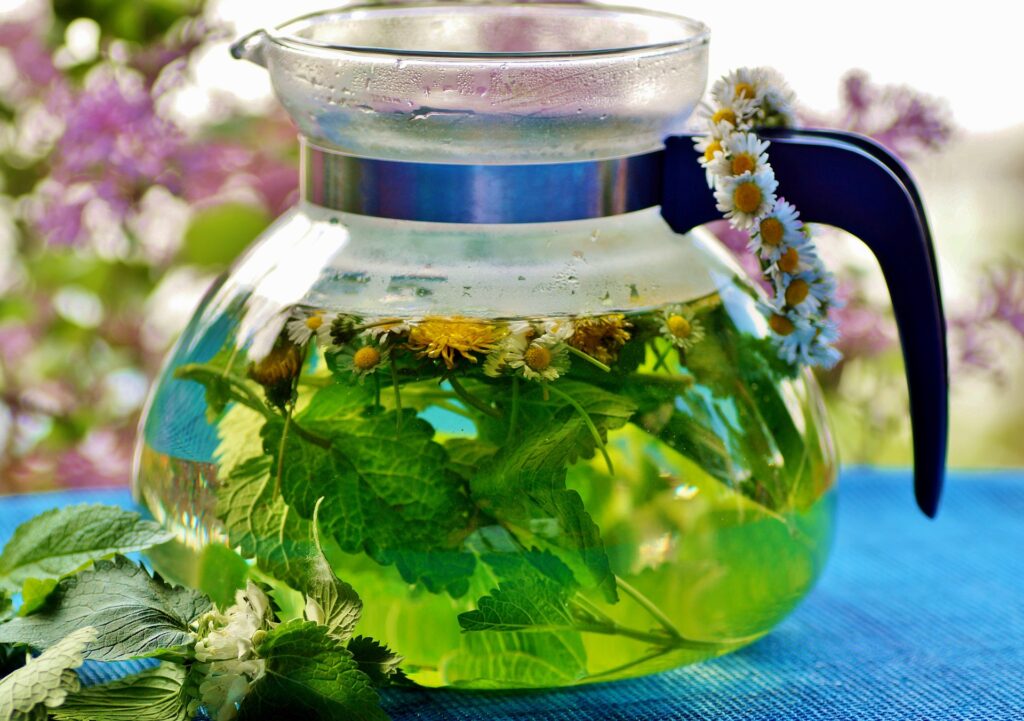
Infusions and decoctions are two techniques for extracting the components of a plant using water. In fact, they’re the oldest and most frequently used. It’s simple, tasty and effective! As well as being an excellent solvent, water forms the basis of our food chain and poses no allergic constraints.
What’s the difference between an infusion and a decoction?
Both are aqueous solutions (with water as the solvent). Infusions are prepared below boiling point, while decoctions are simmered in simmering water.
Decoction is often used for harder plants or plant parts that are more difficult to deliver their active ingredients. Because boiling produces water evaporation, decoction also allows greater concentration (of certain compounds – for example, the tannins in an astringent cream ). That said, the high temperature of a decoction destroys other active compounds, so a decoction is not necessarily more therapeutic than an infusion.

Choose to make an infusion or decoction, depending on the part of the plant used.
Infusions:
Infusions are made from the softer parts, such as flowers and leaves.
Also included are all preparations in which the mucilage is extracted from emollient plants. Mucilage is easily extracted with water and does not require boiling. For example, the softening properties of the roots of Mallow – Malva maschata and Marshmallow – Althaea officinalis, or the tender inner bark (cambium) of Slippery Elm – Ulmus rubra, can be extracted by infusion (even cold).
Decoctions:
Decoctions are used for harder parts such as roots, bark, branches, seeds, needles and very hard mushrooms like chaga(Inonotus Obliquus).
If you wish to use a plant or part of a plant usually prepared by decoction without boiling your preparation, there are a few possibilities:
These alternatives won’t always work. For example, starch doesn’t dissolve (or very little) in cold water, so your rice will remain hard after several hours of cold soaking. But they will work in most cases.

Tips for the best infusions and decoctions
Prefer fresh or freshly dried plants
Dried plants keep well, but over time (oxidation, volatilization, light) your herbal teas will become duller. The fresher the plant, the more aroma, flavor, medicinal virtues and nutritional compounds it will contain. This is particularly true of aromatic species such as lemon balm – Melissa officinalis, feverfew – Tanacetum parthenium and basil – Ocimum basilicum. That said, there are rare exceptions, such as buckthorn(Frangula alnus), where you need to wait 1 year (or dry at high temperature) for the toxic compounds to volatilize.
Adjust plant quantity
We’re not all the same: a child will need a smaller quantity than an adult. Some people are more sensitive, and our taste for bitter or strong flavors varies. It’s best to start gently, in small doses. Difficult flavors are often beneficial in small doses, so listen to yourself and don’t force an intense herbal tea.
Don’t forget that a fresh plant contains between 70 and 85% water. So to convert a recipe from dry to fresh plant, multiply the weight by 5. To convert a fresh plant recipe into a dry one, divide by five. It’s not perfectly exact, but it gives a good order of magnitude.
Use the purest water possible
For infusions and decoctions, distilled or reverse osmosis water will be more effective than mineralized water (see the section on water, an amazing solvent for a chemical explanation). If distilled or osmosed water is not available, make sure your water is as unpolluted as possible.
Discussions about whether or not pure water (H2O) is fit for human consumption do not apply, as water is used as a solvent. When the infusion or decoction is ready, it will have gained plenty of active components, including minerals, trace elements and vitamins.
Cover your hot dishes
Essential oils play an important role in both aroma and therapy. Although they have little or no solubility in water, they do volatilize when heated. It would be a shame to let them go up in smoke. To avoid this, cover and allow the vapors to cool.
The toxicity of essential oils can be frightening for those who want to improvise their herbal teas. Essential oil concentrates are made from a large quantity of plants, and the oils are separated from the plant’s totum. The virtues and dangers of essential oils are not the same as those of a plant. When you make an infusion or decoction, you necessarily lose certain compounds that have volatilized. Thus, the essential oil concentration of an infused plant will always be lower than that of the fresh plant, which explains why it’s safe to take one rosemary tea a day, whereas taking the essential oil internally is neurotoxic.
For large doses and long-term use, read the dosage instructions carefully. For occasional use, if the fresh plant is edible in a given quantity, its infusion is also safe. If you have a special condition: pregnant women, allergies, taking medication… it’s always wise to check the precautions associated with a plant.
Don’t boil your infusions
At boiling temperature, some active agents will be denatured. A decoction does not necessarily have the same properties as an infusion. That said, it won’t become toxic if you let it boil. Taste it and see which flavors you prefer.
Adjust infusion and decoction times
In general, the longer the infusion, the more active compounds are extracted and the stronger the taste (especially the bitterness, which takes longer to develop). So adjust the infusion time to suit your tastes. It’s better to drink a less-infused herbal tea more often than to throw away a more nutritious one.
A fresh plant will not give as easily as a dried one. A good approximation: you can increase the infusion time by 50% or even double it for a fresh plant, and increase the decoction time by 30 to 50% for a dried plant. That said, there’s nothing like tasting the preparation to know when it will be to your liking.
The “thermos” pressed method
If, like me, you rarely have the time to stand by your pot and make sure your water doesn’t go over the boiling point, you can put your herbs and warmed water in a thermos flask for the duration of the infusion. And if your thermos is fitted with a filter, all you have to do is open the cap to drink it directly. You can try and observe how the taste changes according to the infusion time, and discover your own preferences.
Cold maceration
Cold maceration involves placing a plant in water without heating it. The process is generally slower (1 to 8 hours). For macerations lasting more than 4 hours, it is advisable to reheat the solution to just below boiling point before consumption, in order to kill any harmful micro-organisms that may have developed in the appetizing mixture of water and plants. Macerations can be prepared with other solvents such as alcohol and oil, which are covered in other articles.

Cold water can dissolve sugars, proteins, mucilage, pectin, tannins (and most mineral salts).
Solar infusion
A solar infusion is a cold maceration in which the aqueous solution is left to benefit from the sun’s rays. Gardeners are familiar with this technique, which transforms their water into a delicious cocktail. This somewhat poetic technique is appreciated by those interested in subtle energies, as it brings us closer to the energy of the plant.

Water, an astonishing solvent
Water’s polarity enables it to attract both positive and negative charges

The molecule is made up of one oxygen atom (positive), which attracts negative particles, and 2 hydrogen atoms (negative), which attract positive particles. Thanks to this polarity, the water pulls the compounds from the plant and dissolves them in the water. In mineralized water, the mineral salts are dissolved in the water, taking the place of the plant components, so to speak, and reducing the water’s solvent capacity. The purer the water, the better the solvent!
Water is a poor solvent for all non-polar substances (such as oils). Other solvents are needed, such as oils and alcohol. There is no absolute solvent. While alcohol is better for dissolving oils, it is ineffective for mucilages… which is why it’s important to know which active compounds you’re looking for, and sometimes to multiply extraction methods.
Recognizing plant quality criteria
Organic quality plants
Water can also release chemical components (pesticides, colorants, perfumes). So it goes without saying that it’s best to look for plants from healthy, natural environments.

of plants used
Remember that a wild-picked plant is no more organic than the place where it was picked. Again, it’s a question of trusting the picker.
Imported plants have generally been certified according to the rules of the country where they were grown. Not all organic products are created equal. It’s best to look for local production.
Wild or cultivated plants?
Wild plants often have a good reputation: having been watered and fed less, they must have developed a deeper root system and captured a greater diversity of nutrients than plants raised in optimized cultivation. That said, some natural crops grown in living soils make excellent medicinal plants.
Personally, I prefer the plant with which I have a bond. If I’ve grown or picked a plant myself, I provide it with a healthy, diverse environment and develop a respectful bond with it. The plant becomes an ally, a friend rather than a commodity. It’s like lovingly prepared food, which has an intangible but real advantage over the big chain restaurants. What’s more, when you go to pick or grow a plant, you’ll be taming it, learning to distinguish its smell, color, shapes and perhaps even its energy. With a bit of observation, you’ll be able to pick selectively, so that you pick only what the plant offers you at its peak, without weakening it.
If you don’t have access to live plant material and need to buy a plant, use sight and smell to assess its quality. Look for recognizable plants (not powdered) with a bright smell and color. Try to buy local and, if possible, talk to the grower or find out about the company that produces it.
Conservation
Aqueous solutions

Water is the source of life. This is true not only for humans, but also for micro-organisms. A water-based solution at a moderate temperature is ideal for enzymes, molds, bacteria and so on. There‘ s no danger in consuming a freshly cooled solution. At room temperature, the solution will keep for 4 to 6 hours. In the fridge, it will keep for up to 3 days, but should be reheated (until the water boils) before consumption. If you want to keep it longer, you can freeze it or add preservatives such as sugar, honey and alcohol (this is called making a syrup)!
Dried plants
For more information on drying and preserving dried plants, see the article on drying.
The right tools for infusions and decoctions
If possible, avoid aluminum in your kitchen, including pots and slow cookers.
A good thermos: there are plenty of options on the market. Personally, I like models with a double glass wall, which have a built-in filter and are easy to clean. Double-walled glass provides good insulation to prevent heat loss, and the glass allows you to see the color of the infusion and better control the brewing time. On the other hand, they are brittle and heavy.