
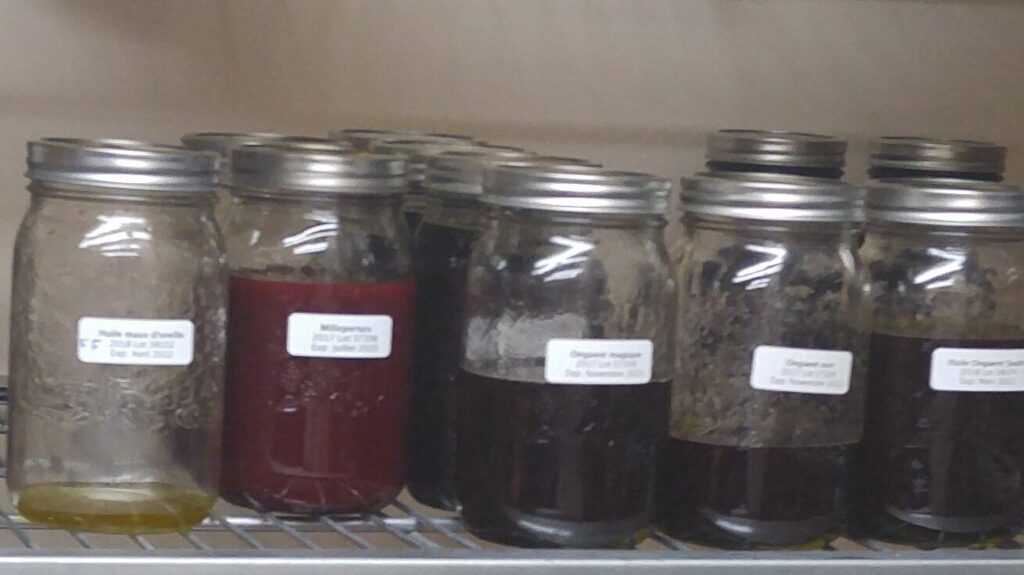
Liquid extract is one of the most widely used processing methods for concentrating and preserving the active ingredients of medicinal plants. This process is perfectly feasible at home. With this processing sheet, you’ll have all the information and tips you need to produce high-quality products with little effort and simple tools.
Why are liquid extracts so popular?
It’s so convenient. Liquid concentrates have a long shelf life. They’re ready-to-use and can be used to make therapeutic products and recipes. Alcohol-based liquid concentrates are readily available over the counter.
A liquid concentrate is in fact a cold maceration of a plant with a solvent, usually alcohol, vinegar or glycerine.
Are liquid concentrates, tinctures and mother tinctures the same thing?
They’re all liquid extracts. Tincture is the extract where the solvent is alcohol; for mother tincture, the alcohol used must be at least 94%. Personally, I reserve the use of strong alcohol (over 60%) for specific cases involving components that are difficult to extract, such as resins and waxes.
Principles for creating liquid concentrates
Solvents extract, concentrate and preserve a plant’s active ingredients.
To maximize the effectiveness of your solvent :
-
Finely chop or grind the medicinal plant;
-
Extend maceration time, depending on solvent and plant, from a few days to a few months;
-
Shake the jar regularly.
How do I make a liquid concentrate?
-
Check the quality and cleanliness of the plant to be used;
-
Finely cut (or grind) the part to be used, see cutting tools for optimum application;
-
Mix the plant and solvent in a macerating jar;
-
Identify the concentrate: plant name, solvent name, maceration start date, filtering date;
- Leave to macerate;
-
Filter the concentrate once through a fine sieve or cheesecloth;
-
Allow to settle for a week, then filter again through an unbleached coffee filter;
-
Check that no solid particles remain in the mixture (if so, repeat steps 6 and 7);
-
Sterilize bottles and bottle;
-
Identify each bottle (plant name, solvent name, bottling date, expiration date, plant/solvent ratio used).
Proportions
Proportions are important, as they influence the concentration of active elements in the concentrate, and therefore dosage. Keeping proportions constant eliminates a factor of variation, resulting in more repeatable quality products.
In other words, you can make a concentrate with more solvent, but you have to adjust the dosages. When you get used to one dosage for a given problem, it’s better to keep it and repeat the transformation in the same proportions.
Check the plant data sheet for ratio recommendations.
Maceration temperature for liquid concentrate
Unless otherwise indicated for a specific plant, alcohol and vinegar liquid concentrates are macerated at room temperature.
Maceration time for a liquid concentrate
The specific maceration period for each plant can be found in the plant data sheets. Generally speaking, vinegar- and alcohol-based liquid concentrates are macerated for about 1 month. Roots and seeds are macerated a little longer, and leaves and flowers a little less.
Here again, the advantage of respecting the maceration time is above all to have a product that’s as repeatable as possible. Don’t go crazy: a variation in maceration time of less than 5% will have a negligible effect, and you won’t need to adjust your dosage.
Shelf-life and storage of a liquid concentrate
Storage times vary according to different parameters.
We can greatly increase the periods below by protecting our concentrates against: light, temperature variations, oxygen (if you have a large quantity, transfer a small quantity into a small airtight bottle for frequent use).
- Concentrated in vinegar: best before 2-3 years;
- Concentrated in alcohol: best within 7 to 10 years.
It could be even longer: an experienced herbalist told me that a 40% concentrate in alcohol lasts 40 years… but that may be a bit of an exaggeration. After the periods indicated above, inspect your products carefully. Signs of aging: precipitation of solids, presence of fermentation gases, change in odor.
The right components
Should I use fresh or dried plants to make a liquid concentrate?
There is no universal answer to this question.
-
On the one hand, fresh plants have the most active components. Some components are necessarily lost during drying, but the difference is not necessarily enormous;
-
Generally speaking, solvents are more effective on dried plants (the drying process makes them more permeable to solvent). Similarly, you’ll need to increase the infusion time if you’re using fresh versus dried plants;
-
For vinegars with a relatively low acidity level (rarely more than 9%), adding a fresh plant that contains a lot of water can make them unstable. But this can be countered by adding more vinegar and increasing the number of drops per day.
For the solvent, is alcohol better than vinegar?
Alcohol is the most widely used solvent, but vinegar also has its supporters; here are a few arguments for each so you can choose for yourself.
Vinegar with at least 8% acidity
In Canada, vinegar concentrates are not yet authorized for over-the-counter sale (Health Canada’s Natural Product Registration (NPN)). They are, however, legally available from herbalists. It has not yet been demonstrated that these products are sufficiently stable and effective to be sold over the counter. Opinions are divided on the subject, and there are not enough studies to tell the difference. Here are the arguments in favor of vinegar:
- Vinegar is a better solvent than alcohol for: enzymes, bitter principles, minerals and vitamins B and C;
- For many components, vinegar has an extraction power comparable to that of alcohol;
- It’s a good alternative for those who can’t or don’t want to drink alcohol;
- Vinegar is good for the body, helping to balance pH and mineralize the body;
- It can be easily integrated into our diet, for example by adding it to our homemade vinaigrette.
Alcohol 40% and over
40% alcohol is superior to 8% vinegar for essential oils, waxes, resins, camphor and chlorophyll. For fresh plants, the quantity of active ingredients is increased by raising the alcohol percentage to 60%. Alcohol concentrates are more stable (less chance of precipitation) and keep longer.
If you can’t or don’t want to consume alcohol
You have the following options:
-
Use vinegar-based concentrates;
-
Evaporate the alcohol contained in the concentrate drops by immersing them in a cup of very hot water. Note that traces of alcohol will remain;
-
Explore the other galenic forms available for a plant: fresh, capsule, herbal tea, maceration. The method of processing influences the proportion of active elements and their assimilation, but there are many options; it’s best to look for the one that really suits you.
An example to illustrate which components to choose
Example: do I choose fresh or dried cayenne to make my liquid concentrate?
- Cayenne’s most sought-after compound is capsaicin. It dilutes well with both solvents. That said, cayenne also contains a number of vitamins and minerals;
- Fresh cayenne contains around 60% water;
- In a concentrate with 1 part fresh fruit purée to 3 parts vinegar;
- Let’s say that 1 part = 100g; we have 60g of water for one part of cayenne;
- For solvent, I use either organic apple vinegar with 9% acidity or 40% vodka;
If we add these 60g of water to the 300g of vinegar (9%), the water will lower the acidity concentration to 7.5%, which is perfectly acceptable.
If I wanted a liquid concentrate to add to a gargle for a sore throat, I’d choose vinegar for the following reasons:
- It’s gentler on the mucous membranes;
- It’s richer in vitamins and minerals.
Knowing that the melting point of capsaicin is > 200°C, I would prefer dried cayenne for my vinegar concentrate.
On the other hand, if I wanted an extra-burning liniment for external use to reduce osteoarthritis-related pain, I’d choose a base of 40% vodka and fresh fruit purée. Alternatively, knowing that capsaicin is soluble in fats, another possibility would be maceration in olive oil.
In conclusion, the decision factors are as follows:
-
In what forms can I obtain the plant?
-
Which active ingredients do I want to focus on? And what use do I want to make of the product?
-
How effective is the chosen solvent for the desired molecules?
The right tools
Containers
For all concentrates, glass containers with airtight seals are ideal. Tinted glass is preferred for storage, as it protects preparations from light.
-
Use plastic lids (as metal oxidizes); alternatively, place plastic wrap between contents and lid;
-
Avoid pipettes, as vinegar softens the rubber.
Cutting tools
-
For an alcohol-based concentrate, you can use the alcohol to cut your plants in a food processor. Because alcohol doesn’t tend to foam, you ensure maximum exposure of the plant to its solvent;
-
For a vinegar-based concentrate, cut the plants by hand before placing them in the vinegar. Vinegar concentrates are vulnerable to oxidation. Avoid preparing them in a food processor, or the preparation will tend to foam up (thus adding more air to the mixture).
Filtering tools
For the first filter, use a very fine sieve or cheesecloth. To filter, squeeze the mixture and remove as much water as possible. Consequently, you’ll need a fairly sturdy filter.
Then, for the second filtration, you want an extremely fine filter to ensure that the tincture is free of solid particles. The unbleached coffee filter works very well. I use it in a large funnel to hold it in place.