






3 categories to avoid mixing culinary recipes with garden purins and herbal transformations:


Culinary recipes
Looking for inspiration on how to put the plants you grow on your plates to good use? Here are the original herbal tea and garden recipes! For more inspiration, we invite you to take a look at the Use section of our plant fact sheets.

Edible flowers from the garden bloom my salads!
A short guide to edible flowers in your garden.

Herbs that make salads taste even better!
Herbs are superfoods, easy to grow and bursting with flavor and nutrients. This article will stimulate you to grasp all the wonderful things they can do for you.
Herbal transformations
Would you like to transform and preserve the medicinal properties of your favourite plants? Whether you’re just starting out, or want to brush up on the basics, these articles are for you!
What you can do with fresh plants

How to Dry Medicinal Plants for Maximum Potency
Drying medicinal plants is the most common form of traditional preservation. With this processing sheet, you’ll have all the information and tips you need to easily produce products that are superior to those on the market.

How to Make Isotonic Eye Drops at Home
Collyrium is the liquid used for eyewash.

How to Make Perfect Infusions and Decoctions
Infusion and decoction are simple techniques for enjoying the aromas and virtues of plants. This article describes
tips and principles for successful and intuitive preparation.

Step-by-Step Guide to Oily Maceration
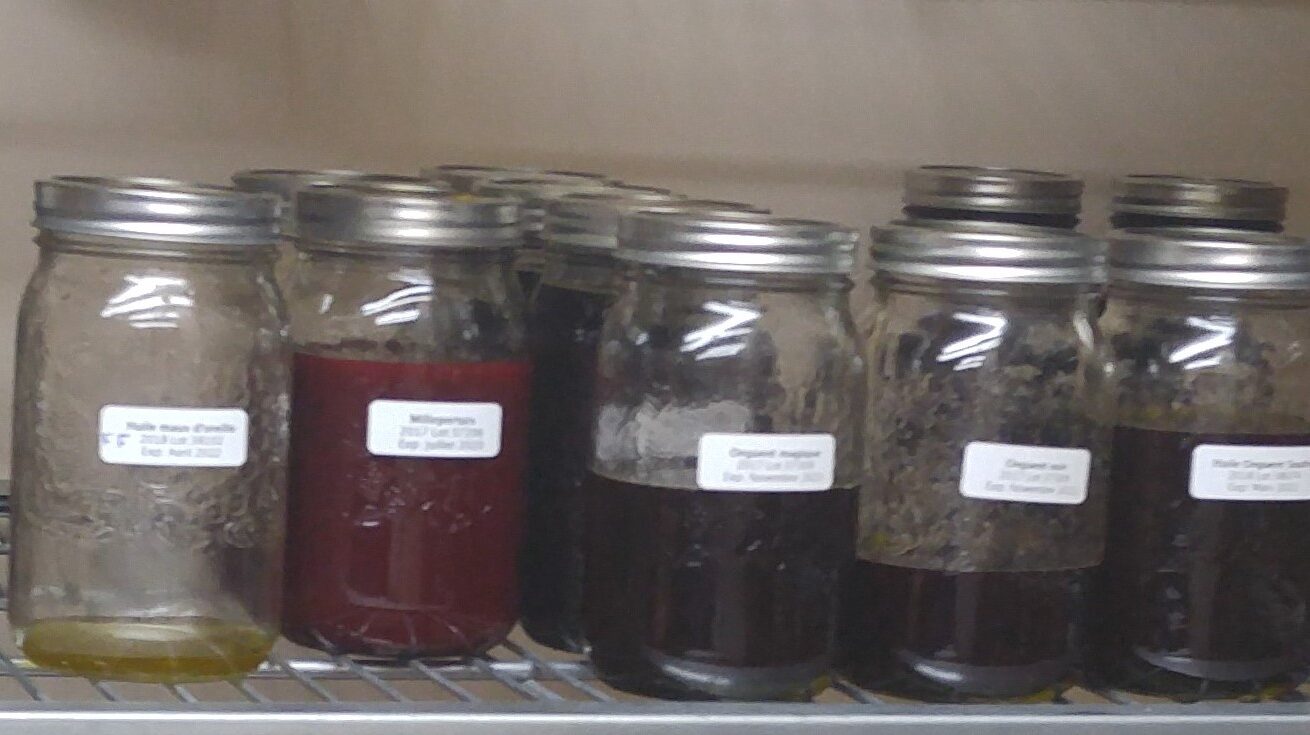
A maceration is an oil “pimped” with the active principles and aroma of plants. This article explains how to make oil macerations to enjoy your plants when the garden is snowed in, your skin is dry from the heating and your bones are more sensitive than usual.
Understanding Liquid Extracts: Tinctures and More
Liquid concentrate is one of the most widely used processing methods for concentrating and preserving the active ingredients of medicinal plants.
What can we do with our primary transformations?

Essential Ingredients for Homemade Liniments
A liniment is a liquid formulation applied externally (to the skin) to relieve aches and pains. This article explains its uses and how to make your own liniment.

How to Create Your Customized Herbal Formula
This article proposes a simple methodology for making therapeutic formulas based on the properties sought in connection with a problem.
Garden recipes
Here are our garden recipes, listed in alphabetical order of the problems the recipe addresses. We’ll soon be preparing complete fact sheets on crop problems. These will help you identify problems and understand the mechanisms that promote or, on the contrary, control them. In the meantime, we’ve added a brief description of the problem to help you find your way around.

Tetranychus urticae
Photo credit: Rasbak
Some very common mites, such as Tetranychus urticae (weaver mite) and Tetranychus turkestani, attack a wide range of cultivated plants.
They develop on herbaceous plant organs, often on the underside of leaves, along the veins. #ref:216#
These mites are highly fecund, with females laying from 2 to 10 eggs per day, depending on the species. At 30°C, incubation takes place in four days, compared with 22 days at 15°C, and new generations are able to lay eggs only 3 to 10 days after hatching.#ref:63#
Their bites cause discoloration or colored reactions in the affected organs, impairing their development and proper functioning.
They sometimes weave abundant webs on plants.
Weaver mites overwinter as females, congregating and sheltering under bark, bud scales and weeds, as well as in greenhouse structures.#ref:216#
Tansy infusion / decoction
This recipe is a good repellent for many insect pests.

The whitefly is a small white midge, 1 to 3 mm long, which flies off easily when you pass it.
There are almost 1,200 species.
These insects have a wide variety of plant hosts and can attack hundreds of cultivated and non-cultivated species, whether in open fields in warmer regions or in greenhouses in colder ones.
They cause considerable damage, particularly to vegetable plants, both through the direct damage they cause by feeding on plants (generally stinging the leaves), and by transmitting viral diseases.
Whiteflies are vectors for over a hundred species of plant-pathogenic viruses.
Tansy infusion / decoction
This recipe is a good repellent for many insect pests.

Flea beetles have highly developed hind legs and jump when disturbed, earning them their nickname of “garden fleas” or “ground fleas”. Their name comes from the Greek haltikos, meaning “skilful at jumping”. Flea beetles range in size from 2 to 5 mm, and are dark and glossy in color. The length of their antennae varies from half to two-thirds of their body length, depending on the species.
In the vegetable garden, flea beetles are often found on brassicas such as cabbage, radish, turnip, rocket and watercress. Some flea beetle species also attack other plants such as artichokes, potatoes, eggplants, tomatoes, beet, chard and vines.
Tansy infusion / decoction
This recipe is a good repellent for many insect pests.

Slugs can measure from 1 to 30 cm and weigh from 1 to 40 g. Slugs have four tentacles, two of which serve as eyes and the other two as scents and tastes. They can feed on plants (phytophagous) or other animals (carnivorous).
Slug life cycles, population density, reproduction and growth are conditioned by climatic conditions, light and food availability. Mild winters favor the survival and development of eggs and young slugs. Dry, cold winters can lead to a reduction in the number of slugs living on a plot.
Slugs play an important role in the ecosystem, controlling vegetation and recycling organic waste. They are also a source of food for many species, including birds and hedgehogs.
However, slugs are often regarded as pests by farmers and gardeners, who resort to specialized pesticides to eliminate them. Unfortunately, these pesticides have proved to be polluting and toxic for many other species. Toxic-free alternative methods are not very compatible with intensive agriculture, which has led to the disappearance of many invertebrates, including slugs, victims of the use of these pesticides.#ref:63#
Tansy infusion / decoction
This recipe is a good repellent for many insect pests.

Photo credit: Rude
Downy mildew is the generic name for a series of cryptogamic diseases affecting many plant species, but taking on epidemic proportions in certain crops of great economic importance, such as grapes, tomatoes, potatoes, lettuce or squash.
The term “mildew” results from the phonetic francization of the English mildew properly “honey dew”, from the Old English mildēaw, meledēaw “honeydew, mildew”.
These diseases manifest themselves as brown spots or a cottony white moldy appearance, followed by a general wilting of the leaf, a twig or the whole plant.
Fungicide-resistant downy mildews appear to be increasingly common in vineyards, particularly in France, prompting a number of official recommendations. The phenomenon has been observed throughout the world, as far afield as Australia, where it seems to have recently spread, as well as in the United States, where the diversity of downy mildew strains is higher, and in Canada.#ref:63#
Tansy infusion / decoction
This recipe is a good repellent for many insect pests.

Photo credits: Jerzy OpiołaJerzy Opioła
Rusts are cryptogamic plant diseases caused by phytopathogenic fungi. Symptoms of the disease appear as spots or pustules on the leaves.
Rust fungi develop on many different types of plant, including conifers, vegetables such as beans and potatoes, ornamentals such as roses, fuchsia and hyacinths, and cereals such as wheat and barley.
Rusts can weaken plants by damaging their leaves, reducing their photosynthetic function and leading to reduced flower and fruit production. However, in most cases, the survival of the plant is not threatened by the disease. Rusts are most visible in summer and autumn in their telial (spore) stage, making them easy to identify. Although rust is an annoying disease, it is rarely dangerous for plants.
Tansy infusion / decoction
This recipe is a good repellent for many insect pests.