






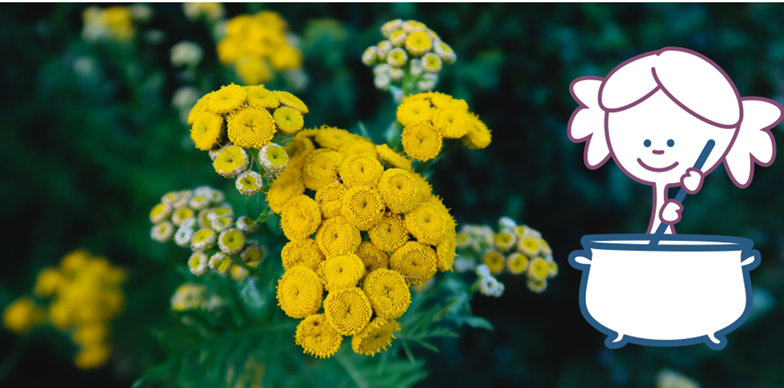
Tansy is a good companion plant for keeping many pests at bay, but it’s best to avoid planting it everywhere (as it is somewhat invasive). It’s best to use only the flowering tops, but you can take all the aerial parts of the plant to make a decoction. You can spray this decoction of tansy on plants that are too bothered by insects. This prevents tansy from reseeding and protects vulnerable plants.
Infusion or decoction?
I’ve consulted several recipes, sometimes called infusions and other times decoctions, but virtually all of them bring the solution to the boil and simmer it for varying lengths of time, so strictly speaking they’re decoctions. I’ve left the term infusion in the title, however, as it’s frequently used. For my recipe, I opted for a short boiling time, but a long maceration, in order to extract the maximum number of active compounds without risking their destruction by heat.
Uses of tansy decoction
Although tansy contains 20 active compounds as a pesticide, 2 as an insecticide and 13 as an insect repellent #ref:67#, decoction or even liquid manure are not very effective at extracting these compounds, so the preparation (which is very aromatic) is mainly used to repel harmful insects (repellent). Gerbeaud also claims that it can inhibit egg-laying by mature insects and feeding by larvae.
To create true tansy-based insecticides, you need to use rubbing alcohol as a solvent, but these are preparations that can cause harm to beneficial insects too. We present this recipe in another article, with the appropriate warnings.
It is also frequently used as a fungicide (mainly against mildew and rust), although like most preparations against fungal diseases, it is mainly effective in prevention.
As for the list of insects that tansy keeps away:
- Ant
- Some flies, including carrot, asparagus and cabbage flies
- Cabbage White
- Striped cucumber beetle
- Sawfly
- Lily beetle
- Certain mites
- Whitefly
- Flea beetle
- Heteroptera
- Tick
- Moth
- Chip
- Raspberry worm
- Slug
- Colorado beetle
- Codling moth
- Leek moth
- Leek worm
According to Bertrand Dumont, tansy, as a companion plant, keeps away Japanese beetles and several noctuid moths#ref:157#… I haven’t really found any references for this use for tansy decoction, but as there isn’t really any alternative to hand-harvesting Japanese beetles, I fully intend to try it this year.
Preparation time
30 min.
Maturation time
1 day before and 1 day after boiling
For people in a hurry, I’d use dried plants (as the compounds are then easier to extract) and compensate for the macerations before and after boiling by simmering for an extra 10 minutes. The cooling phase is compulsory, however, so as not to scald your plants!
Ingredients
- 300g fresh tansy or 30g dried (you can use all the aerial parts of the plant, but prioritize the flowers if you have enough)
- 1 l of water, ideally non-chlorinated (such as rainwater). If you use tap water, leave it uncovered for 1 day to allow most of the chlorine to evaporate.
- Optional: ½ tbsp. black soap (olive oil-based) per liter of diluted solution*.
* Black soap is used as a wetting agent, i.e. it helps the product adhere to the plants, so it will last longer. What’s more, it’s a contact insecticide, meaning the insect has to touch it for it to block the larvae’s pores and prevent them from breathing. It can therefore potentiate the decoction. However, it is harmless to mammals, fish and birds.
Preparation
- Cut the plant finely
- Add water and macerate for 1 day.
- Bring to the boil for 5 to 10 minutes.
- Leave to infuse and cool for 1 day
- Filter
- Dilute and, optionally, add black soap
- Spray
Concentration of tansy decoction according to use
Use the solution diluted to 10% as a foliar spray. In the case of heavy infestation, you can gradually try lower dilutions, but you’ll need to test a few leaves to make sure you don’t burn plants with delicate foliage.
In the case of codling moth of apple, pear and walnut trees, and carrot, asparagus and cabbage flies, it is generally used undiluted.
Frequency of application
Spray tansy decoction every two or three weeks, more often if it rains.
If you’re using it as an insect repellent, keep an eye on their return to find out the right frequency.

Take care
In humans, the plant is slightly neurotoxic and can also cause kidney damage if consumed for too long or in high doses, but it is used in small doses as a spice (similar to pepper) or as a medicinal plant. See the plant sheet for edible and medicinal uses of tansy. Foliar spraying of the decoction should not cause any health concerns for the gardener, but to be on the safe side, I recommend you wear goggles when doing any foliar spraying, even organic!
Over-concentration of the decoction and the use of black soap can damage foliage such as that of Japanese maple, nasturtium, lily, bleeding heart, begonia, fuchsia, geranium, impatiens, etc. In short, if you decide to try higher concentrations, test on a single leaf, wait one day and spray the plant only if there is no damage. In short, if you use black soap or decide to try higher concentrations, test on a single leaf, wait 1 day and spray the plant only if there is no trace of burning on the test leaf.
Never apply foliar sprays in bright sunlight, but rather in the morning or late afternoon.
Preserving tansy decoction
Unfortunately, the decoction will not keep for more than 2 days in the fridge. It is therefore preferable to prepare only small quantities at a time.
You can dry your flowering tansy so that you always have some on hand to make a decoction. Alternatively, you can make a tansy liquid manure, which can be kept all summer long. These preparations can be used interchangeably.